Deadly Mistakes Travelers Make Renting Foreign Cars
From insurance traps to wrong-side driving fatalities, these critical errors cost travelers their money—and sometimes their lives.
Renting a car abroad offers travelers unparalleled freedom to explore foreign landscapes at their own pace, yet this convenience comes with substantial risks that catch thousands of tourists off guard every year. The deadly mistakes travelers make when renting foreign cars range from financial disasters that drain vacation budgets to genuine life-threatening situations on unfamiliar roads. Understanding these hazards before picking up the keys at an overseas rental counter can mean the difference between an enriching adventure and a catastrophic experience that haunts travelers long after they return home.
Insurance Confusion: The Costliest Rental Car Trap

Insurance remains the single most problematic aspect of international car rentals, with travelers routinely misunderstanding what coverage they actually possess. One of the biggest mistakes people make when renting a car in Europe is not understanding how rental car insurance works or anticipating extra fees during the trip. The complexity begins with terminology that varies between countries and companies, leaving renters vulnerable to gaps they never knew existed.
The collision damage waiver, commonly known as CDW, illustrates this confusion perfectly. Every rental in Iceland comes with basic collision cover called CDW, but it does not make travelers safe. It leaves drivers liable for an excess that can run to hundreds of thousands of króna, and it typically does not cover the damage that actually happens in that country, including gravel chips, sand and ash blasting, tires, and windscreens. Many travelers assume that having CDW means they are fully protected, only to discover the painful truth when minor damage results in significant charges.
At the slightest damage—a scratch in the parking lot, a stone chip, a dent—travelers can be left with an excess of €1,000–€3,000. The math becomes devastating quickly: a small parking damage incident in Italy without full coverage means a €1,500 excess charge, while the same incident with proper full coverage costs nothing additional. American travelers face particular challenges because most U.S. auto insurers will not cover drivers while abroad, except in Canada and certain Mexican border regions.
Critical Insurance Gap
Within the European Union, the Green Card system facilitates cross-border travel, but coverage can vary significantly outside this framework. A policy providing comprehensive coverage in France may offer only basic third-party liability in neighboring Switzerland, leaving travelers exposed when crossing borders.
The Credit Card Crisis at the Rental Counter
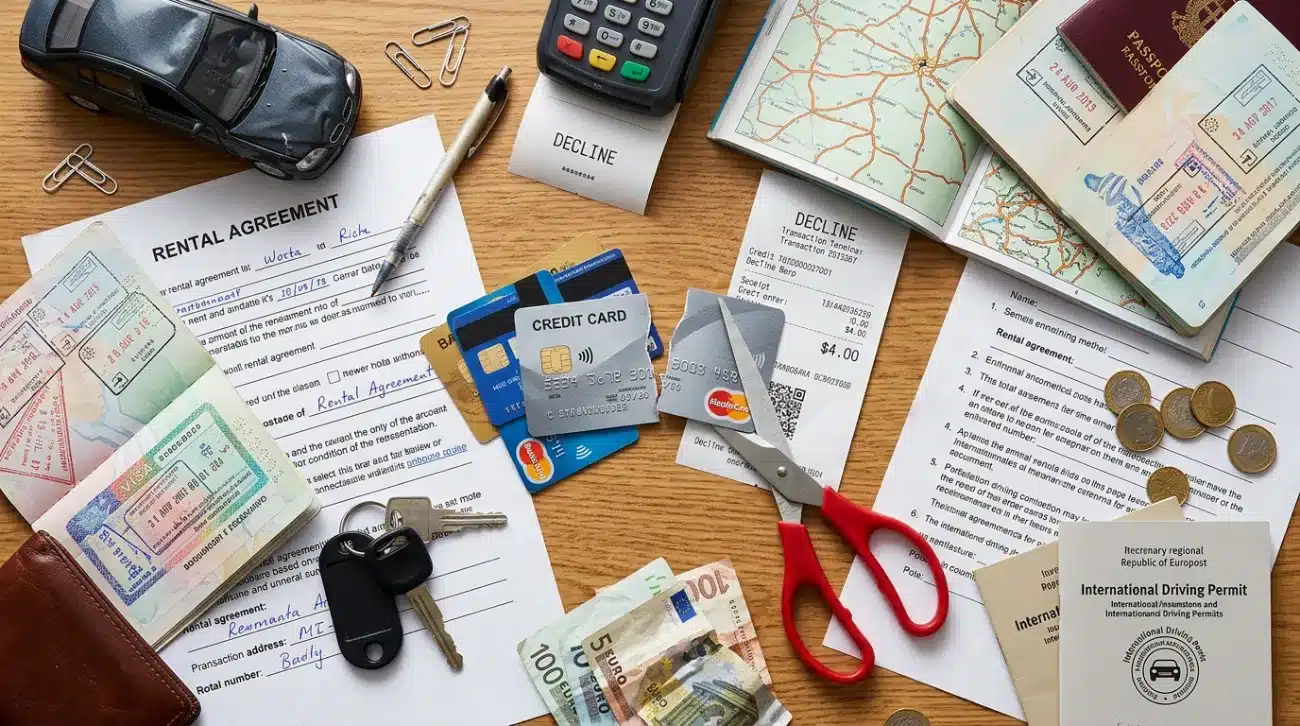
Few situations frustrate travelers more than arriving at a foreign rental counter, exhausted from a long flight, only to discover their payment method is rejected. In ninety-nine percent of cases, travelers need a credit card in the driver’s name to rent a car internationally. Debit cards are often not accepted, and suddenly travelers find themselves standing at the counter without a vehicle and without options.
The security deposit hold compounds this problem in ways many travelers fail to anticipate. When picking up a rental car, the agency places an authorization hold on the credit card—not a charge, but a hold that freezes available credit. For economy cars, this might be $500, but for SUVs, sedans, or any vehicle rented internationally, this hold can reach $1,500 to $2,500. This frozen amount counts against available credit, potentially leaving travelers without sufficient funds for hotels, meals, and emergencies during their trip.
Credit cards used to pay the deposit are often refused by car rental companies, either because of alleged technical problems or insufficient funds. Customers are then offered additional insurance for a fee as the only alternative, creating pressure to purchase coverage they may not need or want simply to obtain the vehicle they already reserved.
Documentation Failures and International Driving Permits

The question of whether travelers need an International Driving Permit varies dramatically by destination, and getting it wrong carries serious consequences. More than 75 countries legally require an International Driving Permit, and driving without one can mean fines, voided rental insurance, or vehicle impoundment. For U.S.-licensed drivers, an IDP is commonly required in countries including Australia, Austria, Bulgaria, the Czech Republic, Estonia, Germany, Italy, Poland, Romania, Serbia, Slovenia, Slovakia, Spain, and Thailand.
The requirements become even more complex in certain regions. Japan, Brazil, and Thailand all require an IDP for foreign drivers, with Japan and South Korea applying strict national rules about the permit’s format and issuing channel. Thailand, Cambodia, Indonesia, Malaysia, and the Philippines legally require an International Driving Permit for foreign drivers, and Thailand and Indonesia recognize only the printed one-year booklet, not a digital copy. Police checks on tourist drivers, particularly scooter and motorbike renters, are routine in these countries.
China Exception
Mainland China does not recognize foreign permits at all. Visitors need a local Chinese license to drive legally, making car rental effectively impossible for most tourists without extensive advance preparation.
Wrong-Side Driving: When Mistakes Turn Fatal

Perhaps no rental car mistake carries more devastating potential than driving on the wrong side of the road. For travelers from right-hand-drive countries visiting left-hand-drive destinations—or vice versa—the adjustment challenges muscle memory developed over years of driving. What happens is that people drive off and they forget which side they should be driving on, as one official noted regarding tourist accidents. The U.S. Embassy explicitly warns its visiting citizens that tourists driving on the wrong side of the road are the cause of several serious accidents each year in left-drive countries.
The consequences can be tragic. A coroner in New Zealand called for “Keep Left” stickers to be compulsory in rental vehicles after a Swiss tourist drove on the wrong side of a Taranaki highway and died in a collision. In another documented case, an English motorcyclist died in Utah after driving on the wrong side of the road, a fatal confusion stemming from the difference between his home country’s left-side driving and America’s right-side traffic patterns. The other tourist traveling with him narrowly avoided the same fate by swerving at the last moment.
The danger intensifies during specific circumstances: after making turns at intersections, when exiting driveways or parking lots, or during moments of distraction or fatigue. Speed limits can be posted differently or change more frequently than expected, roundabouts may follow different priority expectations, and parking rules in cities can be far stricter or more complex than travelers anticipate.
The Damage Dispute Nightmare
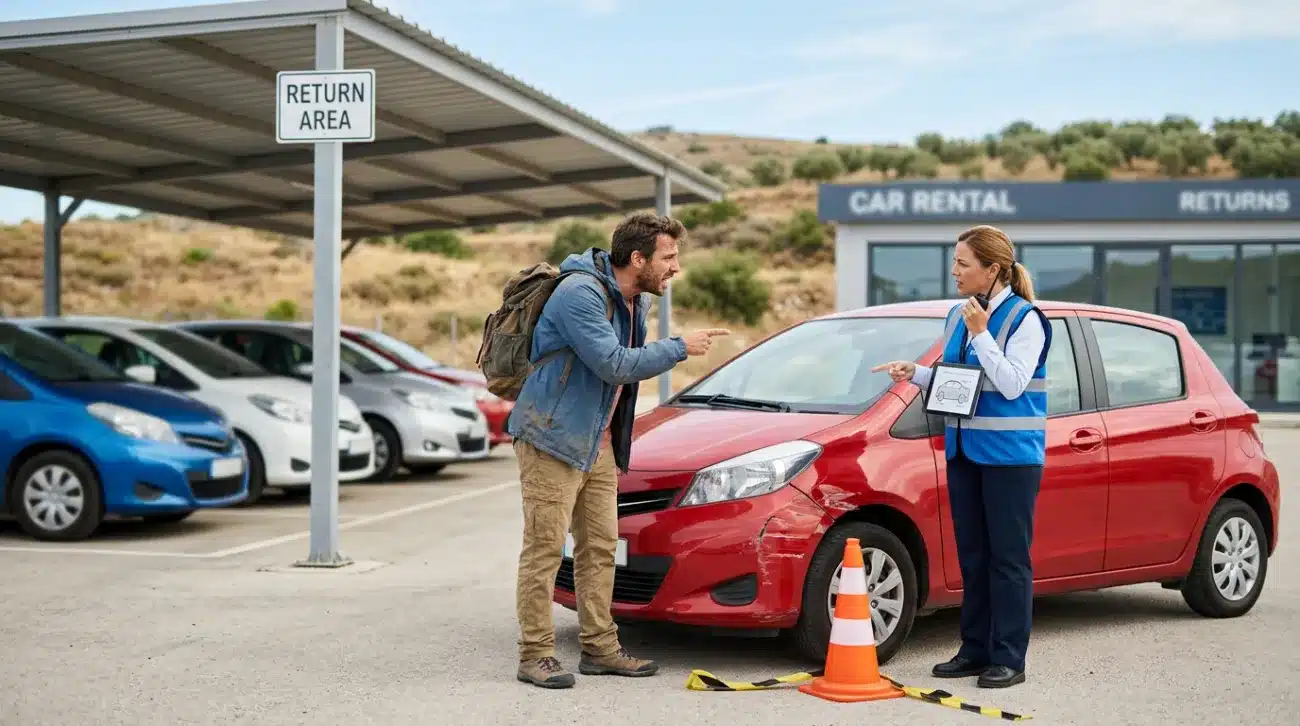
Travelers who believe their rental experience ended successfully often receive unwelcome surprises weeks later when damage charges appear on their credit cards. A damage scam happens when an agency charges for a scratch, dent, or interior stain that existed before the driver picked up the vehicle. The pattern is distressingly common: travelers return the car and head to the airport thinking things are fine, then later receive a repair bill for some recently noticed damage they did not cause.
The vulnerability stems from inadequate documentation at pickup. Travelers tired after long journeys often skip thorough vehicle inspections, eager to begin their trips. Even minor scratches or damage can later be disputed if they are not clearly recorded at pickup. Three weeks after a rental, travelers may receive invoices for alleged damage to door panels or other components—damage that may have existed before they ever touched the vehicle.
At Pickup
Photograph and video the entire vehicle—all sides, roof, wheels, and interior. Document existing damage in close-up shots and ensure all damage is noted on the contract before driving away.
At Return
Repeat the documentation process and request a signed receipt confirming the vehicle’s condition. Never return a vehicle when the counter is closed if possible.
Payment Protection
Always use a credit card rather than debit to maintain chargeback rights if disputed charges arise after returning home.
Hidden Fees That Inflate Rental Costs
The advertised price of a rental car often bears little resemblance to the final bill, with numerous fees adding substantial costs that catch travelers unprepared. Common additional charges include airport surcharges, young driver fees, and charges for extra equipment such as GPS or child seats. Failing to read the fine print can result in unexpected costs that inflate rental budgets well beyond initial expectations.
New fees continue emerging that travelers may not anticipate. Since January 1, 2026, Iceland has stopped collecting road tax through fuel and instead charges every car on the road per kilometer, including travelers. As of recent reports, the rate for an ordinary car is 6.95 ISK per kilometer, appearing as a separate line on rental invoices rather than in the daily rate. For a full lap of Iceland’s Ring Road—around 1,400 kilometers—this fee comes to roughly 10,000 ISK.
Fuel policies represent another area where confusion leads to extra charges. Travelers who fail to understand whether they must return vehicles with full tanks, or who misunderstand prepaid fuel options, often pay significantly more than necessary. The rental terms may include mileage limits, prohibited areas—such as restrictions against driving from Spain to Morocco—and specific conditions regarding damage that only become apparent when violations occur.